The urgent need to decarbonise energy-intensive industries is driving demand for innovative electrification solutions. Among the technologies enabling this transition, large heat pumps, or LHPs, play a pivotal role in reducing emissions from the papermaking process.
A prominent example of their potential in the pulp and paper industry is the world’s largest steam-generating heat pump, currently operating at the Delfort group facility in Tervakoski, Finland.
The papermaking process generates substantial quantities of low- to medium-temperature waste heat, primarily in the form of wastewater and humid air produced as water is removed from the paper web during manufacturing. Despite their energy potential, these heat sources are often underutilised because their temperature is generally too low for direct process-to-process heat integration.
Large heat pumps bridge this gap by acting as a thermal link that upgrades waste heat into high-value process heat or steam at temperatures of up to 200–300°C.
By replacing natural gas combustion with high-efficiency electrification, LHPs offer a mature and readily deployable pathway towards achieving the 2050 Net Zero targets.
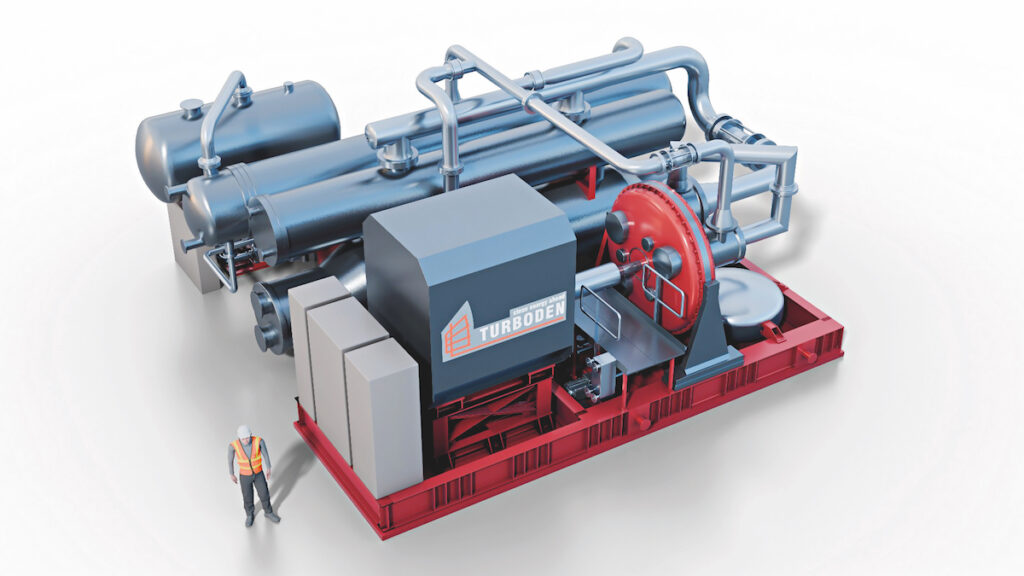
As industries increasingly adopt these solutions to decarbonise heat-intensive processes, technology providers are focusing on the development of reliable and advanced systems capable of meeting demanding industrial requirements. In this context, TURBODEN, part of the Mitsubishi Heavy Industries Group, supplies high-performance large heat pumps for both conventional and high-temperature applications, covering capacities from 5 to 80 MWth and delivering heat at temperatures of up to 300°C.
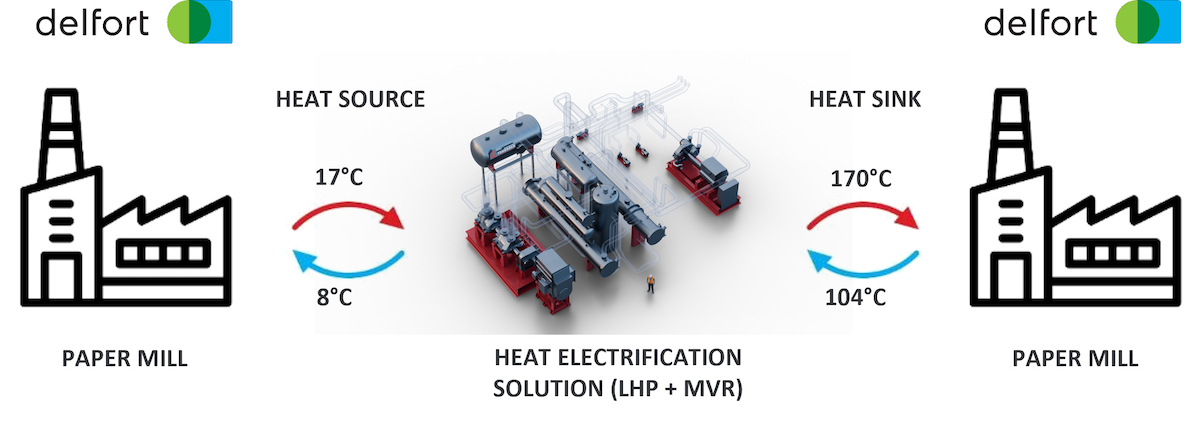
In 2026, Turboden delivered and commissioned a first-of-its-kind LHP system at the delfort Group paper mill, demonstrating an innovative configuration for steam generation. The system recovers low-grade process waste heat through an intermediate water loop. This thermal source is used to evaporate a hydrocarbon refrigerant within the heat-pump cycle, which is subsequently compressed and condensed to generate low-pressure steam at 1.4 bar(a).
A centrifugal steam compressor then upgrades the steam to the conditions required by the process.
The installation provides 12 MWth, corresponding to approximately 20 tonnes of steam per hour, with a coefficient of performance, or COP, of 2. It supplies superheated steam at temperatures of 150–180°C and a pressure of 3.4 bar(a) for the paper drying process.
The principal engineering challenges addressed during commissioning included the optimisation of the high-temperature fluid and thermodynamic cycle, the integration of turbomachinery and steam-compression technology, the selection of corrosion-resistant materials and the development of control strategies for dynamic operating conditions.
Commissioning also validated essential operational features, including surge prevention during paper web breaks, rapid warm-start capability and stable load modulation. These results confirmed the system’s ability to operate reliably under actual paper mill conditions.
The Delfort project represents a breakthrough for the pulp and paper industry, demonstrating that electrified steam generation at high temperatures and on an industrial scale is both technically viable and economically competitive. It establishes a replicable model for replacing fossil-fuel-based steam generation with efficient heat-pump-driven solutions.
Torna indietro