Paper manufacturers are increasingly required to provide resistance to water, grease and water vapour while preserving recyclability, processability and compliance with international food-contact regulations. These requirements are driving the development of a new generation of water-based coating technologies.
Among the most promising solutions are advanced aqueous wax dispersions. Compared with conventional barrier systems, these technologies can offer an effective balance between functional performance, application efficiency and environmental compatibility. Recent developments in microcrystalline wax technology have extended the performance range of coatings for paper and paperboard, particularly in demanding food-packaging applications.
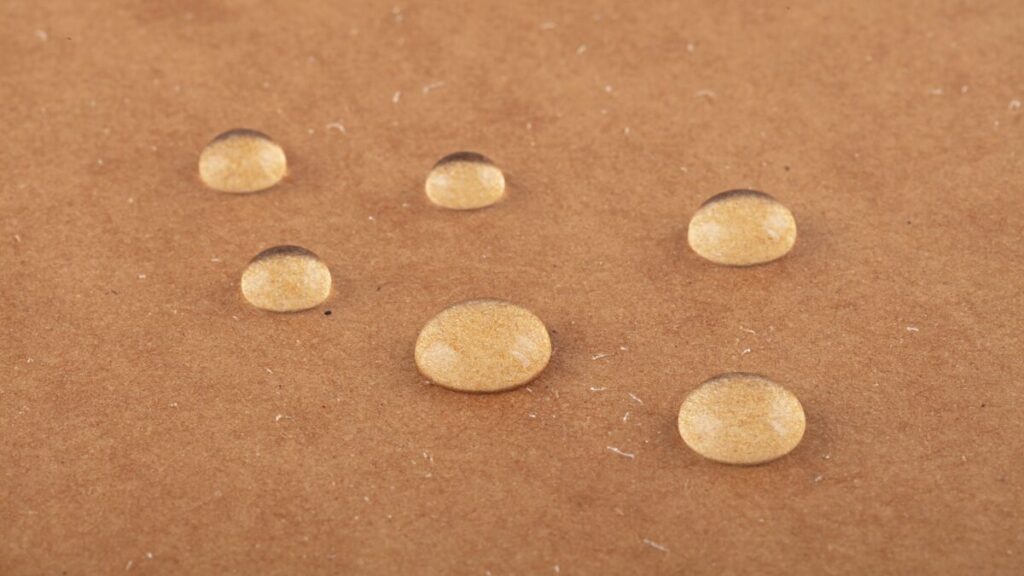
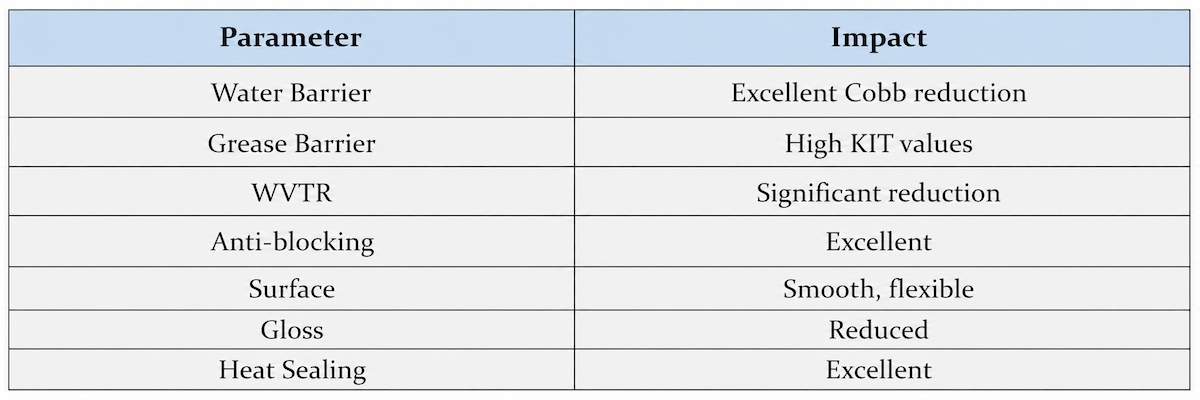
One example is Synthro-Wax MI 914 D, a high-solids aqueous dispersion containing 40% microcrystalline wax, developed by SYNTHRON, the paper chemicals division of PROTEX INTERNATIONAL. The product has been formulated to combine excellent resistance to water, grease and water vapour with outstanding anti-blocking performance, while maintaining a smooth, flexible and non-tacky coating film. A pronounced water-beading effect and reduced surface gloss further improve the appearance and functionality of the coated paper.
A key feature of the formulation is its optimised emulsification system, developed to achieve high barrier performance while limiting the surfactant content. Once incorporated into a coating formulation, the product preserves the recyclability of the paper substrate, making it suitable for the development of circular fibre-based packaging solutions.
From a converting perspective, the high solids content provides significant operational advantages. The lower amount of added water reduces the energy required for drying and can improve machine productivity, while also decreasing transport and storage costs. These benefits are becoming increasingly important as manufacturers seek to combine environmental improvements with greater economic improvements.
The formulation complies with major international food-contact regulations, including Regulation (EU) No. 10/2011, FDA 175.300, 176.170 and 176.180, and German BfR Recommendation XXXVI. Unlike many paraffin-based alternatives, it is suitable for direct contact with fatty foods without restrictions, extending its potential use in food-packaging applications. The product is also biocide-free, supporting safer handling throughout the production process.
Laboratory testing highlights the performance potential of the technology (Table 1).
Although microcrystalline wax dispersions represent only one possible approach to barrier coatings, their ability to combine technical performance, regulatory compliance and compatibility with existing water-based coating processes makes them an increasingly attractive option for paper manufacturers.
As fibre-based packaging continues to replace more complex multilayer structures, innovations of this kind are expected to play an important role in supporting both product performance and the transition towards a more circular packaging economy.
Torna indietro