
When we look at most products in stores today, we see a great proliferation of packaging: toothpaste tubes, pasta packages, moisturizers, perfumes, chocolate boxes, mobile phones, adapters, medicines, shoe boxes, chewing gum packs – all requiring cartons of different weights, dimensions and qualities depending on the product.
The quality of the carton used for a luxury perfume or a high-end mobile phone is not the same as that used for toothpaste or a pasta box. From a professional perspective spanning more than three decades, the demand for sheet cutting for various market purposes has changed significantly due to consumption habits and the variety of packaging across sectors like pharmaceuticals, food, cosmetics and perfumery. This has led paper and cardboard manufacturers to develop new qualities targeted more precisely at these sectors.
Additionally, trends in decarbonization and replacing plastic with paper have driven new developments in producing cartons with moisture barriers for food products, replacing previous plastic packaging. We have seen many qualities emerge with diverse surface characteristics, many highly sensitive to friction or abrasion and varying degrees of stiffness for different uses.
Equipment manufacturers have had to develop solutions to handle a wider variety of formats and shorter batches, leading to high levels of automation that reduce setup times dramatically. A cutter in the 1990s required 20 minutes for each format change. Today, those 20 minutes have been reduced to 3 or 4 minutes depending on the machine’s size and automation level. The particularities arising from this variety of substrates and their applications have fostered several lines of work.
New developments
Undoubtedly, past recipes are no longer applicable and the secret lies in evolving and launching market proposals immediately after evidencing that for certain substrate qualities, sizes and finished product formation, difficulties may arise that must be avoided with new developments. These proposals aim to guarantee excellent cutting quality, excellent stacking quality, good stack verticality and agile but sufficiently gentle product evacuation to maintain the desired initial properties and present a perfect pallet at the delivery point.
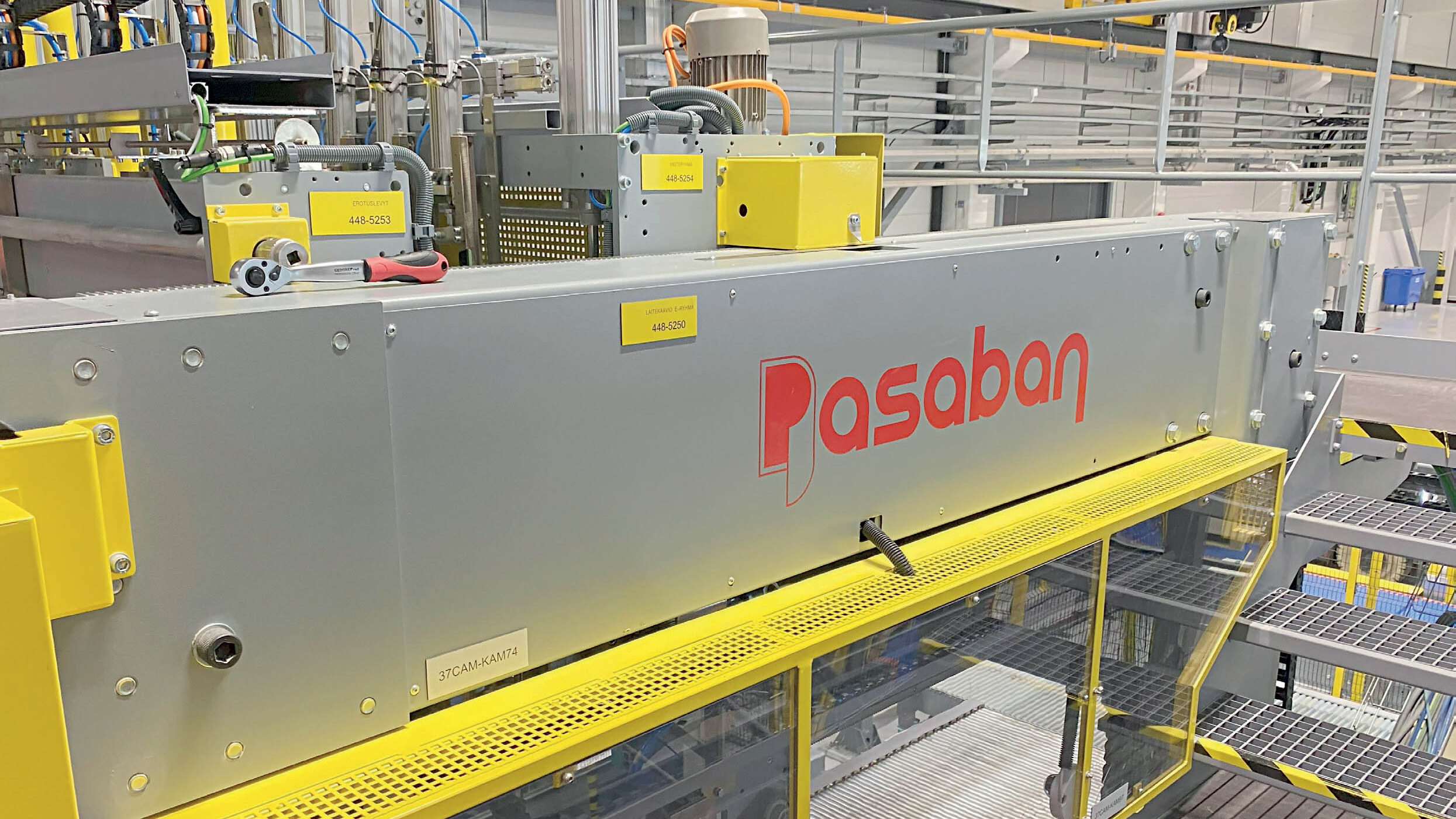
The objective is also to ensure that this delivery, whether it involves a vehicle picking up the finished product (forklift) or a transfer to another machine (e.g., pallet packaging line), is carried out smoothly and fully synchronized. The detailed study of certain design elements, their geometries, the distance between rollers, surface treatments of transfer or passage surfaces, solutions for eliminating static electricity and redesigning certain transmission areas… constitute Pasaban daily business.
It is not only about ensuring one case but learning from as many cases as possible and putting into practice solutions that have been tested and validated to overcome certain difficulties. In this sense, new developments are not only conceived to solve the particular problem they aim to address but also to pay attention to details, use the most suitable materials in each case and apply the necessary control logic and devices to make the whole a fully reliable and low-maintenance or maintenance-free solution.

In this regard, the company has seen design evolution leading to the replacement of hydraulically actuated elements, which are more subject to periodic maintenance (oil changes, cylinder seal changes, etc.) and variable behavior depending on oil conditions, viscosity and temperature… with electrically actuated designs that are more reliable, more easily adjustable through the implementation of all types of drives on the market and even enable closedloop controls for controlled precision movements. This ultimately results in less machine downtime, whether for regular maintenance or complex and costly unexpected breakdowns.
Study and use of new materials
Advancing the testing of new materials is crucial for extending component life, which influences machine availability and ensures maximum production. Pasaban often collaborates with technological institutes in its area, which hosts many specialized companies and institutes in disciplines such as material science and finite element analysis. These institutes support various industries and can conduct detailed studies using prototypes. These studies are followed by real-machine tests to compare results.
For example, Pasaban has occasionally replaced steel in critical components like blade holders with materials such as aluminum or carbon fiber, which offer significant advantages in dynamic behavior. However, maintaining the necessary rigidity for top-quality cutting remains essential. This research has been ongoing for years and validating results and homologating new materials for machine use can take several months.
Greater use of decentralized periphery
This trend is common among equipment manufacturers, but Pasaban’s automation and control department excels in offering open control architecture. This allows easy integration of new devices and scalability as market devices evolve. Its team continuously expands expertise with various peripheries, working with recognized OEMs like Siemens, Allen Bradley and Mitsubishi and using fieldbuses or protocols such as Profinet, Profisafe, Modbus, CANopen, EtherCAT, TCP/IP, Ethernet IP and DeviceNet.

Remote support
Today, equipment manufacturers must offer remote access to resolve or guide end customers through issues. For Pasaban, with operations on nearly every continent, this is crucial. Over the years, they’ve enhanced this capability not only through professional software but also by developing machine hardware that allows their service department to control and monitor various functions.
They can now remotely access the machine’s HMI (Human-Machine Interface) and perform event traceability, access and modify PLC control logic, check encoder status, adjust touchscreen programs and perform detailed event traceability and alarm history review. They can also assess the status of input-output control cards and, in critical situations, view drive parameters and dynamic behaviors.
The company continuous improvement in this area has strengthened its reputation by ensuring high machine availability and minimizing downtime. Remote support addresses two key aspects: a) immediate reaction time and b) reduced repair costs. With urgent issues, its technicians quickly identify and address problems remotely, avoiding costly travel and reducing downtime. The integration of new technologies with its machine design has made these improvements possible.
Visualization cameras
Pasaban has the ability to integrate a visualization camera system that can be used from two different aspects:
a) from the operational aspect, where the machine operator can have a holistic view of the machine’s strategic points and, through simple visual inspection, have an accurate idea of how things are going. In case of detecting an anomaly, they can act quickly before the problem escalates. Pasaban integrates different types of cameras and angles depending on the area to be inspected. Naturally, the placement of these cameras is done in a detailed manner, enabling a good view of the most important locations.
b) from the remote support perspective, where Pasaban can verify their suspicions after the customer has reported a failure and provided an initial personal assessment based on the symptoms they perceive.
AI
The rise of Artificial Intelligence (AI) highlights its potential to transform traditional methods and expedite processes once thought irreplaceable by machines. While AI’s ability to replace human tasks can be both impressive and intimidating, it raises significant ethical and social questions that need addressing to ensure these technologies benefit society. AI is a transformative technology with the potential to revolutionize many aspects of our lives. Its development requires careful consideration to maximize benefits and navigate challenges.
Recognizing AI’s potential, Pasaban has enhanced its business by integrating advanced solutions and continuously seeking improvements based on user feedback. This often involves exploring unconventional approaches that, though resource-intensive, may yield significant results. Pasaban is exploring AI implementations to streamline processes and improve efficiency. For example, AI can enhance manufacturing through:
1. Predictive maintenance: Analyzing sensor data to foresee equipment failures, allowing proactive maintenance and reducing downtime.
2. Production optimization: adjusting variables dynamically to boost efficiency and minimize waste.
3. Quality control: using computer vision to detect defects and improve product quality.
4. Design assistance: analyzing data to suggest product and process improvements.
5. Inventory management: forecasting demand to manage inventory and reduce costs.
6. Process automation: automating repetitive tasks to increase precision and free up workers for complex tasks.
7. Supply chain optimization: enhancing supply chain management by predicting demand and optimizing routes.
8. Data analysis: identifying patterns for continuous improvement.
9. Product customization: analyzing customer data to offer personalized products.
10. Safety and risk management: monitoring operations to detect risks and prevent issues.
In summary, integrating AI into manufacturing can lead to greater efficiency, cost savings, improved quality and better adaptability to market demands.
Torna indietro