Producers must improve quality, increase output and reduce energy, fibre and chemical costs, while automation systems generate high-frequency data from DCS, QCS, laboratories, maintenance and other sources. The challenge is no longer whether data is available, but whether it can be used effectively.
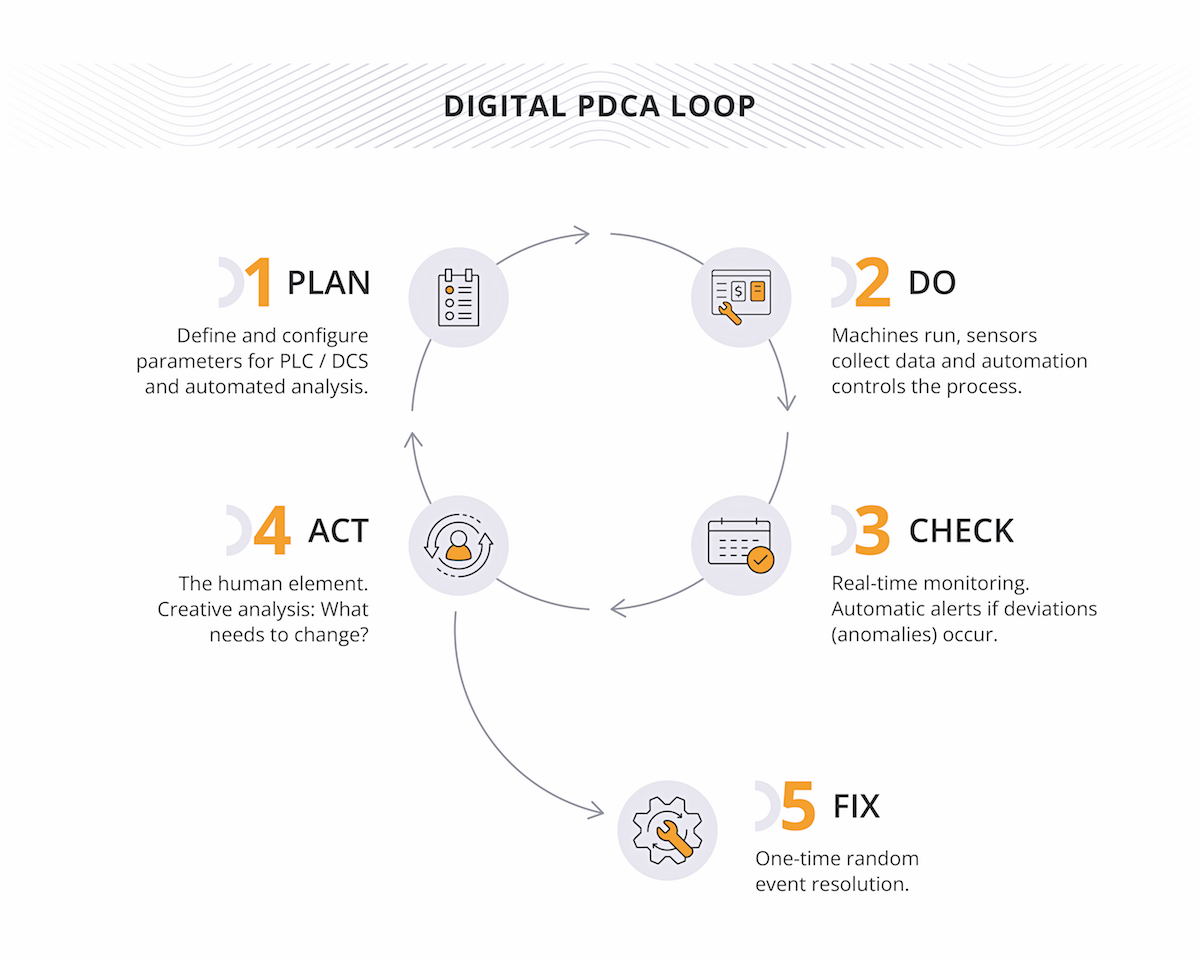
TRIMBLE WEDGE helps mills address this challenge by combining automation, analytics and process expertise within a practical digital improvement loop. Designed for industrial environments, the software supports the Plan-Do-Check-Act, or PDCA, model and applies it directly to daily operations, transforming continuous improvement from management concept into a measurable technical practice.
During the planning phase, mills define target values, control limits, quality specifications and process rules. These parameters guide automation and advanced process control applications, enabling production to be carried out consistently. As the process runs, Trimble Wedge allows teams to monitor performance through dashboards, KPIs, soft sensors and statistical process control tools. Deviations can therefore be identified rapidly, helping teams focus their attention where it is most needed.
The real value emerges when unexpected behavior requires more detailed investigation. Although automated monitoring is essential for routine control, complex process variation still requires human expertise. Trimble Wedge supports ad hoc analysis, enabling users to examine trends, refine data, compare operating periods and identify root causes without requiring specialist data science skills.
Teams can determine whether an event is random or systemic and assess whether an identified relationship should be converted into a new operating rule.
This closes the digital PDCA loop. When analysis shows, for example, that temperature and pH contribute to a quality deviation, the finding can be translated into revised setpoints, control logic or APC parameters. Automation then operates under improved conditions, while automated analysis verifies the result. Process knowledge is therefore incorporated into the mill’s technical architecture rather than remaining dependent on individual experience.
Reliable conclusions require data to be cleansed of outliers, shutdowns, grade changes and other disturbances. Trimble Wedge helps users refine and align data from multiple sources, including delayed process responses, so that measurements can be connected more accurately with their outcomes. This is particularly important in pulp and paper production, where cause and effect are often separated by time and by different sections of the equipment.
Typical applications include centrelining, quality stabilization and energy optimization. Statistical control charts highlight when key variables move beyond their expected limits, prompting investigation and corrective action. Production and energy data can also be analyzed together to identify inefficient equipment, optimize subprocesses and support decisions based on energy cost patterns.
As mills progress towards digitalization and AI-supported operations, automation and human process knowledge remain essential. Trimble Wedge provides the analytical foundation for this collaboration: automation manages monitoring activities, while people apply their experience and judgement to improve the process. The result is a data-driven approach that helps producers improve quality, reduce variability and embed continuous improvement into everyday mill operations.
Reference
Deming, W. Edwards (1986). Out of the Crisis. Cambridge, MA: Massachusetts Institute of Technology, Center for Advanced Engineering Study, p. 88. ISBN 978-0911379013.
Back