Pitch deposits remain one of the most persistent challenges in pulp and paper production. Natural wood extractives released during pulping can form colloidal pitch particles that accumulate throughout the process. These particles may agglomerate and create sticky deposits on equipment, reducing operational efficiency, increasing cleaning downtime and affecting pulp quality.
As mills continue to close water loops and improve process efficiency, pitch management is becoming increasingly important.
For many years, talc has been widely used to control pitch and stickies. Although effective, talc-based programs often require high dosage rates, contribute ash to the process and require dedicated storage and handling systems. In addition, as an inorganic mineral, talc does not actively modify the surface properties of pitch particles.
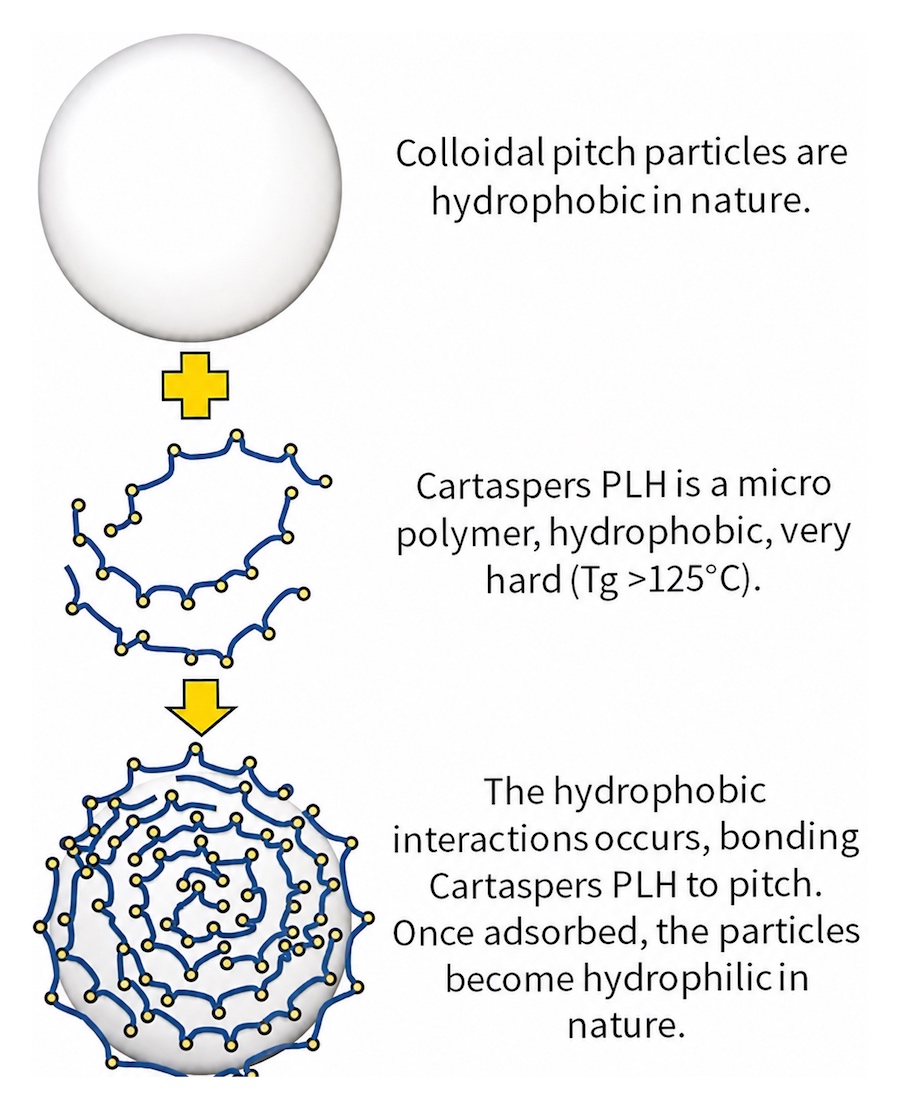
CARTASPERS® PLH Liquid, supplied by ARCHROMA, offers a new approach to pitch treatment. The technology is based on specially engineered polymer particles with a strong affinity for hydrophobic contaminants such as pitch and stickies.
This distinctive mode of action differentiates the technology from other solutions available on the market. Through hydrophobic interactions, CARTASPERS® PLH selectively adsorbs onto pitch particles, forming a protective layer around them.
Once adsorbed, the surface characteristics of the pitch particles change from hydrophobic to hydrophilic. This surface modification significantly reduces tackiness and prevents particles from agglomerating into larger deposits. Instead, they remain dispersed in the process water, where they can be removed more easily from the system.
The mechanism not only controls existing pitch particles but also helps prevent the formation of new deposits throughout the process (Figure 1).
Unlike mineral-based products, CARTASPERS® PLH is a non-abrasive, water-based emulsion that can be easily applied at different points in the process, including brownstock washing stages. Early application allows passivated contaminants to be removed before they reach critical process areas.
Its liquid form also eliminates dust generation and simplifies storage, handling, and dosing operations.
Laboratory evaluations demonstrated the high efficiency of the technology. Approximately 450 g/t of CARTASPERS® PLH delivered similar or better pitch reduction performance than 5 kg/t of talc, highlighting the effectiveness of its hydrophobic affinity mechanism at significantly lower dosage levels.
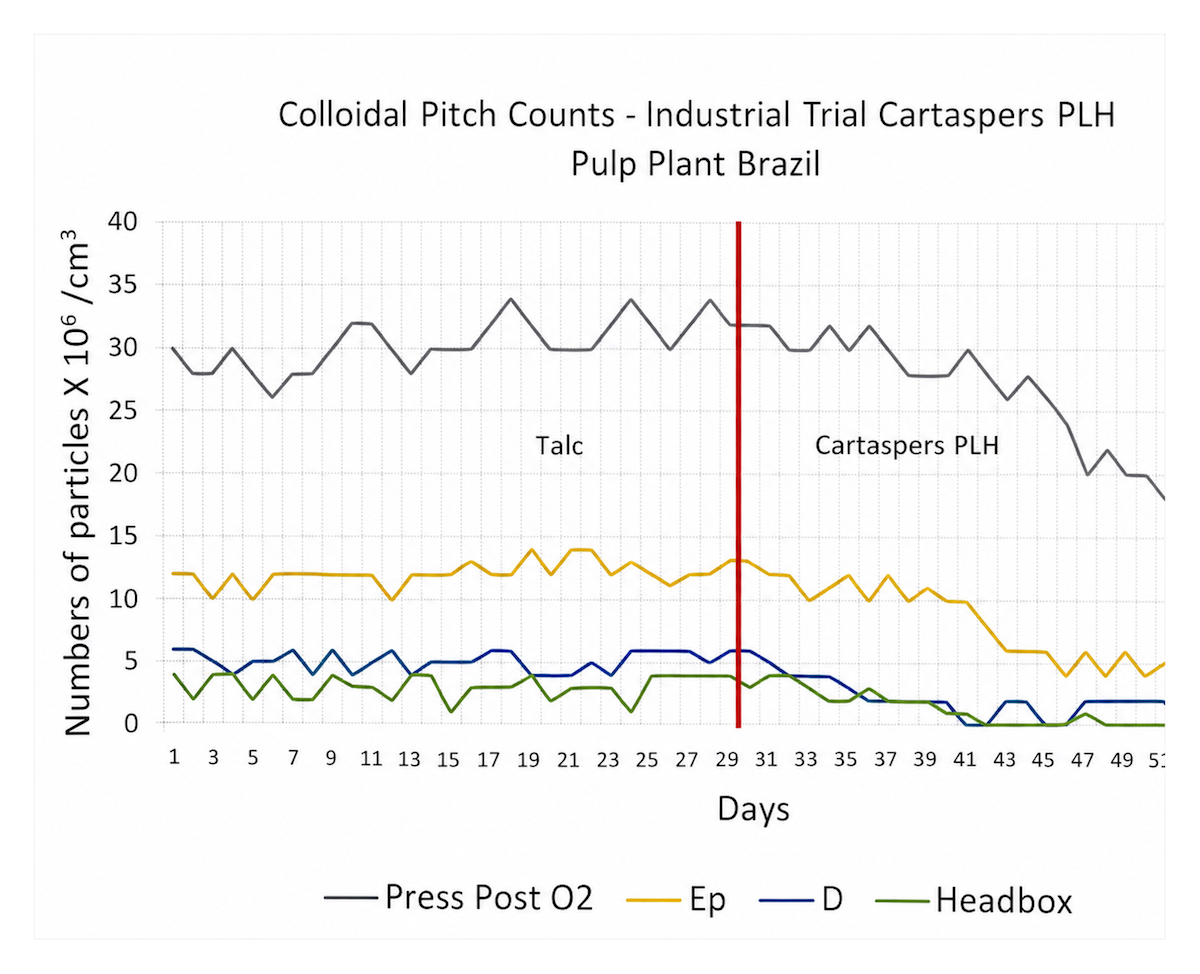
The benefits were further confirmed at an industrial eucalyptus kraft pulp mill in Brazil. Following the implementation of CARTASPERS® PLH, colloidal pitch counts were reduced throughout the process while pulp quality targets were maintained. The mill also achieved lower overall treatment costs and a reduced ash contribution compared with its previous talc-based program (Figure 2).
By combining a unique affinity for hydrophobic contaminants, effective pitch passivation, low dosage requirements, simplified handling, and proven mill performance, CARTASPERS® PLH provides pulp producers with a modern and sustainable solution for pitch and deposit control.
Back