Chemical solutions for oil and grease resistant fibre based packaging
Fibre based packaging lacks inherent resistance to oil and grease, necessitating the incorporation of additional components to provide them grease resistance. Oil and grease resistance (OGR), is the ability to inhibit the penetration of grease, oils and fats. This is important to protect against the accidental transfer of oil, grease and fats from the product or package to the user, and to stop the aesthetic spoiling of the packaging caused by oils, grease and fats penetrating the substrate.
Without a proper protection, oils and liquids can soak into the package and cause the paper fibres to degrade, compromising the package’s structure and creating stains and blotches. The key to expanding the use of fibre based packaging for new and more demanding end-uses is chemistry. Chemistry enables renewable fibre based packaging that not only meet high standards of functionality, durability and safety but also maintain complete recyclability.
Moving beyond PFAS and plastic dependency
Historically, the most common commercial method for imparting oil and grease resistant properties to fibre based food packaging involves the use of plastic or harmful compounds such as per – and polyfluoroalkyl substances, PFAS. Plastic is the predominant raw material in packaging applications, primarily owing to its cost-effectiveness and protective attributes. However, plastic films can cause issues with repulpability and compostability of the final product.
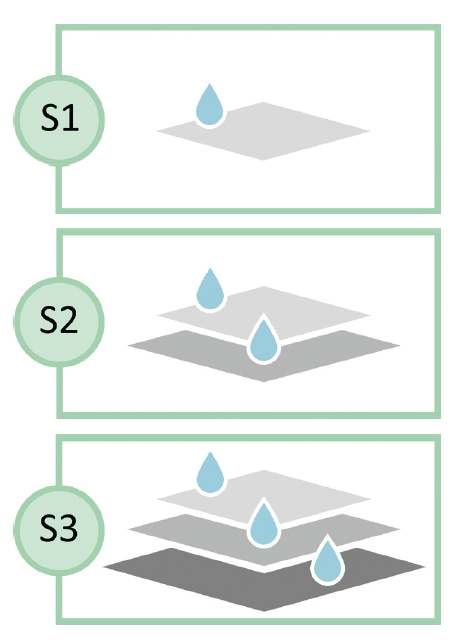
properties are required. To meet the requirements up to three different barriers can then be applied in up to three layers.
The non-recyclable and non-biodegradable characteristics of plastic raise significant concerns about environmental impact, contributing to pollution in both landfills and aquatic ecosystems. Consequently, plastic pollution in the oceans inflicts harm on organisms and sea life. EU rules on single-use plastic products (SUPD) aim to prevent and reduce the impact of certain plastic products on the environment – in particular the marine environment – and on human health.
PFAS are a diverse group of synthetic chemicals with strong carbon-fluorine bonds that are chemically inert and resistant to high temperatures. However, they are often referred to as “forever chemicals” due to their bio persistence, leading to irreversible environmental exposure and accumulation. Furthermore, exposure to PFAS has been linked to carcinogenic effects and potential disruption of the human endocrine and reproductive systems.
This has led to a number of proposed bans and restrictions in several countries, including a restriction proposed by five EU-countries and submitted to ECHA on January 13, 2023. To enhance sustainability and diminish the environmental impact of plastics and PFAS, it is imperative to seek alternative chemistries for fibre based packaging.
PFAS and plastic free chemistry adapted to end-use requirements
There are various application methods employed to impart PFAS and plastic free oil and grease resistance to fibre based packaging. The choice of application method depends on various factors, including the properties of the additives, the desired level of resistance, the type of packaging being produced, and the specific requirements of the end-use applications.
Each method offers a unique approach to achieving effective oil and grease resistance. Manufacturers may choose the method that best suits their production processes and the characteristics they want to impart to the final paper product. At BIM Kemi, they have developed different chemical concepts adapted to specific customer requirements; wet end additives, barrier coatings and combination systems for high demand barrier properties.
Wet-end additives
The oil and grease resistant additives can be added directly to the pulp slurry at different stages of pulp preparation. This allows for uniform distribution of the additives among the paper fibres. By incorporating these additives into the wet end of the papermaking process, it enables paper manufacturers to produce grease resistant paper or board, such as food wrapping paper, pizza cartoons etc, without the need for barrier surface applications on – or offline while maintaining high speed production.
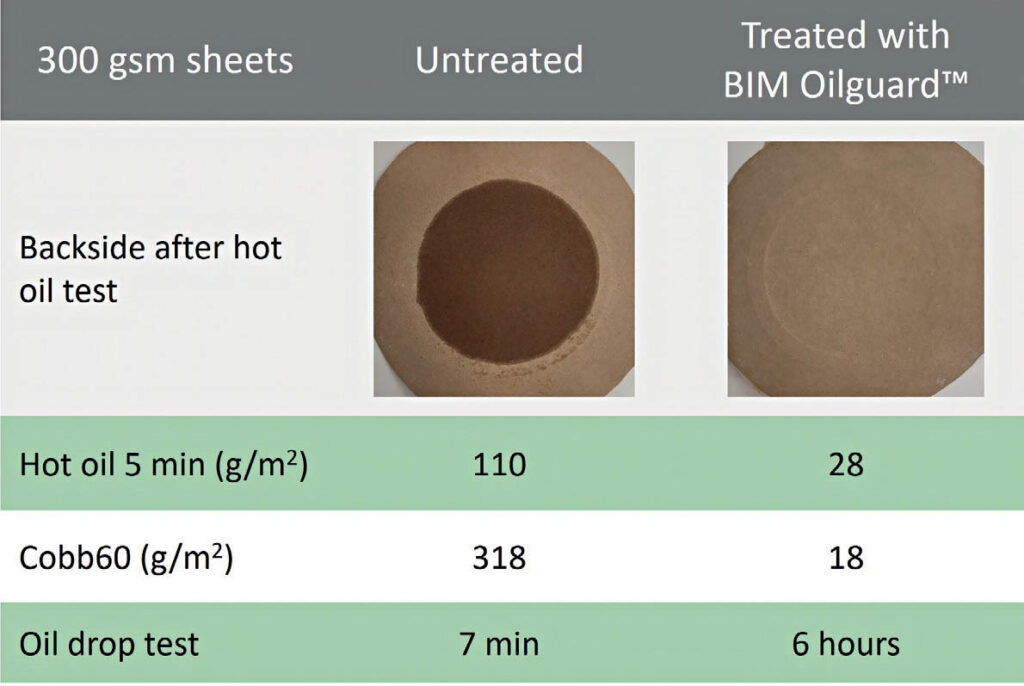
It also enables the production of grease resistant 3D moulded fibre products for fast food/food on the go applications, without the use of a plastic lamination on the surface or PFAS in the wet end. BIM Kemi has developed a novel wet end additive that provides grease and oil resistance, BIM Oilguard™ (European patent pending).
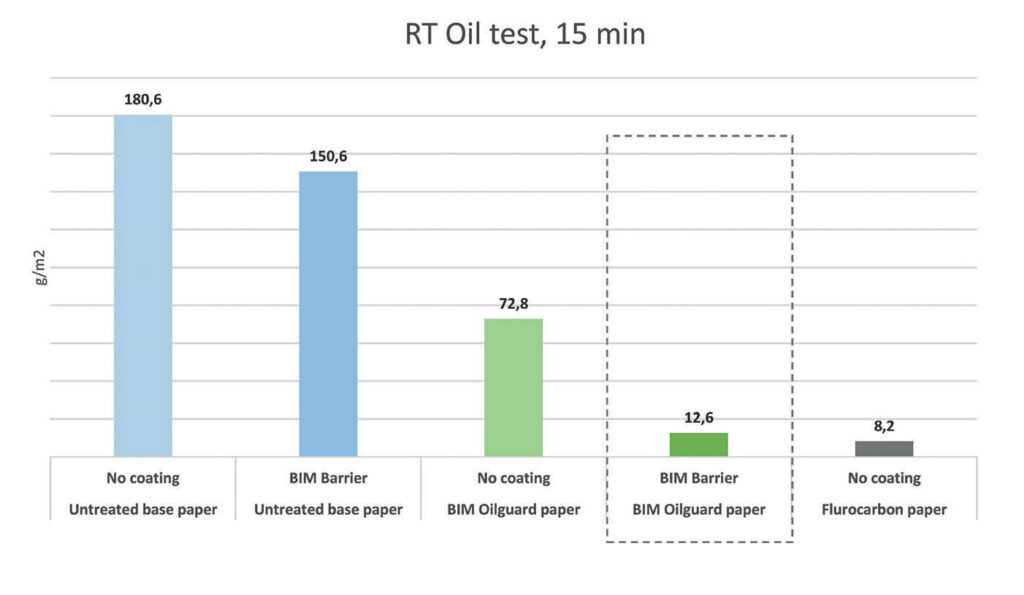
The additive is based on cationic micro dispersions with excellent attraction to the cellulose fibre enabling a good distribution in the pulp suspension and adsorption to the cellulose fibre before forming the paper, board or moulded fibre product. Studies have shown that no retention aids are needed and oil uptake can be reduced by 80% on bleached kraft virgin pulp sheets and by 75% on recycled kraft paperboard (Fig 2).
The additive also gives water resistance but is favourably combined with a traditional sizing agent for optimal water sizing. Performance testing of sheets made from different pulp source treated with the wet end additive show that different pulp types have different optimum dosage levels and give rise to different OGR properties. It is well established that unbleached pulp demonstrate better inherent water sizing ability and in general, requires lower amount of sizing additive. This is also observed when finding the optimum dosage level for BIM Oilguard™. Fine tuning combinations of pulp types and level of refining in combination with BIM Oilguard™, excellent oil and grease resistant properties can be achieved. Additionally, high density and good formation are other important parameters when producing oil and grease resistant fibre based food packages using a PFAS free wet end additive.
Barrier coatings
Barrier coatings are made from water based dispersions that are laid on the surface of paper or board to provide a protective layer against water, moist, oils/fat (OGR) and oxygen. Barrier formulations typically consist of aqueous polymer dispersions (Latex) that forms a non-porous film after evaporation of water. Latex is a stable aqueous dispersion of organic polymer particles.
Typically used polymers are modified ordinary styrene-butadienes, different acrylates and methacrylates, polyolefins, vinylene acetates, copolymers of these or natural biopolymers. Different additives, such as waxes and pigments, can be added to improve functional properties including oil, grease, water and moist resistance. Choice of additive is dependent on desired property of the end product.
Barrier coatings that are made of a blend of polymeric latexes and pigments have high surface energy (lower hydrophobicity) and are widely used as a primary layer to even out paper surfaces and facilitate deposition of a second overlaying coating layer. Barrier coatings based on thermoplastic polymers are often heat sealable with technologies such hot-bar welding, impulse welding and ultrasonic. Effective sealing can be achieved at approx. 100-150 °C depending on contact pressure and dwell time. Heat sealing are typically used in food packaging applications including flexible pouches and bags, as well as tray and bowl sealing for food packaging. The increased focus on recycling and sustainable packaging has driven the trend to replace fossil raw materials in water based coatings with renewable analogues.
Alternative biopolymers, like polysaccharides and lignins, along with bio based waxes can be used for fully or partially biobased coatings. Today, the higher cost, more difficult processing and lower performance in comparison to fossil based, hinders exploitation in many industrial applications. For applications with high sustainability demands, biobased barrier coatings are still interesting alternatives to consider. Introducing viable fully or partly bio based barriers is a focus area in the industry.
Depending on the end-use and desired properties of the packaging materials, different types of barrier coatings, or even a combination of barriers, can be necessary. Therefore, we at BIM Kemi have defined the BIM Barrier Standards. This is a tool to help eliminate overpackaging and achieve optimal use of resources by identifying the requirements for each product.
Combination system
Combining wet end additives and surface coatings in paper and board manufacturing can offer enhanced oil and grease resistance to the final product. The combination allows for a comprehensive approach to enhance resistance throughout the entire paper structure. Combining wet end additives and surface coatings allows for customization without compromising other essential characteristics of the paper and is advantageous for high demand barriers.
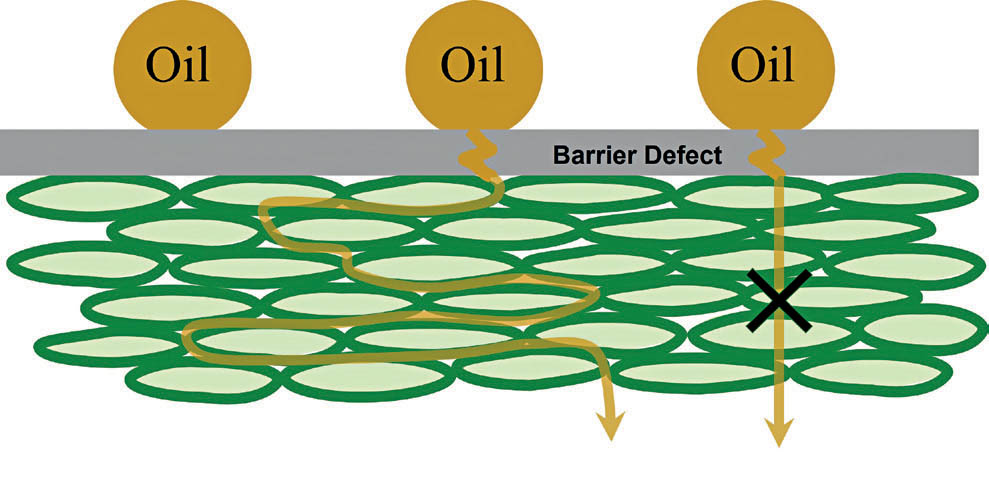
Barrier coatings can only provide OGR to the surface of the substrate and offer no internal protection, i.e., protection from the migration or “wicking” of oils and fats through contact with any cut edges inside the packaging. Here, an internal treatment to the pulp is necessary to give wicking protection. Additionally, adding a wet end additive to the pulp, can enable low grammage weight surface barrier coatings while achieving desired OGR properties. For high demand barriers, a combination of wet-end additive and surface coating is advantageous.
BIM Kemi has developed a new technological innovation significantly improving oil and grease resistance of fibre based paper and board packaging products by combining wet-end treatment, BIM Oilguard™ with barrier coatings, BIM Barrier™. BIM Dual Barrier is especially advantageous for packaging types where it is hard to achieve an even coating, such as 3D-shaped products and low-weight surfaces but can be used for all types of fibre based packaging with higher demands.
With BIM Dual Barrier Concept, similar OGR resistance as PFAS treated fibre based packaging can be achieved with a substantially higher sustainability profile. As a supplier of speciality chemicals, they recognise the potential they and their chemistry hold in enabling the transition to PFAS and plastic free fibre based food packaging, thereby contributing to a more environmentally sustainable future
Back