
Introduction
Accurate consistency control of the stock has a big importance in successful pulp, paper, board or tissue machine operations. This is a key element in mass flow and water consumption management of the mills. Fiber consistency has even a great significance because it is directly related to the principal raw material to make paper or tissue and because it influences basis weight stability and consequently quality and productivity.
When it comes to the choice of the right consistency transmitter for a consistency control loop, several parameters must be taken into consideration and we know there is not a one size fits all transmitter. Some specific process conditions and requirements will lead to the selection of an appropriate technology.
BTG proposes here to describe a unique technology developed by the company, the amplitude method consistency measurement. Available on the market for several years, it has demonstrated its advantages in multiple cases with very good feedback from papermakers.
Process challenges
The following principle about consistency transmitters is often heard in the mills: everything is fine as long as they don’t stand out! If it is true the consistency sensors can do the job for years without trouble, when consistency control problems appear or are finally discovered, the importance of consistency gets back on top of things.
And then it’s not only the transmitter that must be diagnosed but the complete control loop including process conditions, pulp mixing, dilution line, etc… to find the root cause of the consistency control issue. Whether it is a new or an existing installation, consistency control can be challenged by different process issues. Let’s highlight some of them that are commonly met.
Pipes’ arrangement might be hardly suitable for the installation of a shear-force sensor, which provides fiber consistency. This type of sensors requires a certain calming length with a straight pipe to meet plug-flow conditions necessary for its smooth operation. Installation of such sensor, motivated by the need of a fiber consistency control, might lead to constraining piping design or pipe modification.
Flow velocity is a parameter that can influence consistency measurement technologies. The different types of sensors require different minimum flow velocity, that may be sometimes reached only in some section of pipe with smaller pipe diameter. Variations of flow inherent to process location like broke chest, or due to production change can have a negative impact on the performances of static blade shear-force consistency transmitters.
Fiber composition can be, for some production, leading to a stock made of very different fibers. From a mix of bleached hardwood and softwood to a mix of unbleached softwood with OCC for example, the conditions for measuring consistency vary a lot for all technologies available. The issue is overcome with few sets of calibration when fiber mix are fixed and identified or by using technologies more versatile like microwave, optical or Ampliforce™.
Fines and Fillers are part of the stock, and together with fibers, the combination is measured in the pulp and paper process as total consistency. As long as fines or filler content increases in the stock, it’s important to keep it under control to avoid the risk of reaching a right total consistency, but with not enough fibers to make a right sheet of paper. This is where an accurate fiber consistency control will bring all its benefits.
Pulp slurry properties are also some conditions to consider. Variations of air content and conductivity of the stock will modify the velocity of microwaves, while air bubbles and dark-colored pulp might affect reflection or transmission of optical beam. Either these variations must be properly compensated in the internal signal management system of the consistency measurement technology, or the process issue must be removed, for example, by increasing pressure in the line to decrease air content, which represent a certain additional cost. Presence of contaminants like knots or stones in pulping process, or like wire, plastics or metal pieces in waste paper repulping are different possibilities of damaging or blocking shear-force consistency transmitters, which require extra protections. Finally, ph, pressure and temperature of the media determine metallurgy of pipes and all related elements of the consistency control loop.
Amplitude method consistency measurement
As mentioned before, online fiber consistency measurement is based exclusively on shear-force technologies. Whereas static blade and active blade measurement methods come with minimum performance, the rotating measurement method is a well-known, robust, proven and highly accurate fiber consistency measurement method provided for decades by BTG.
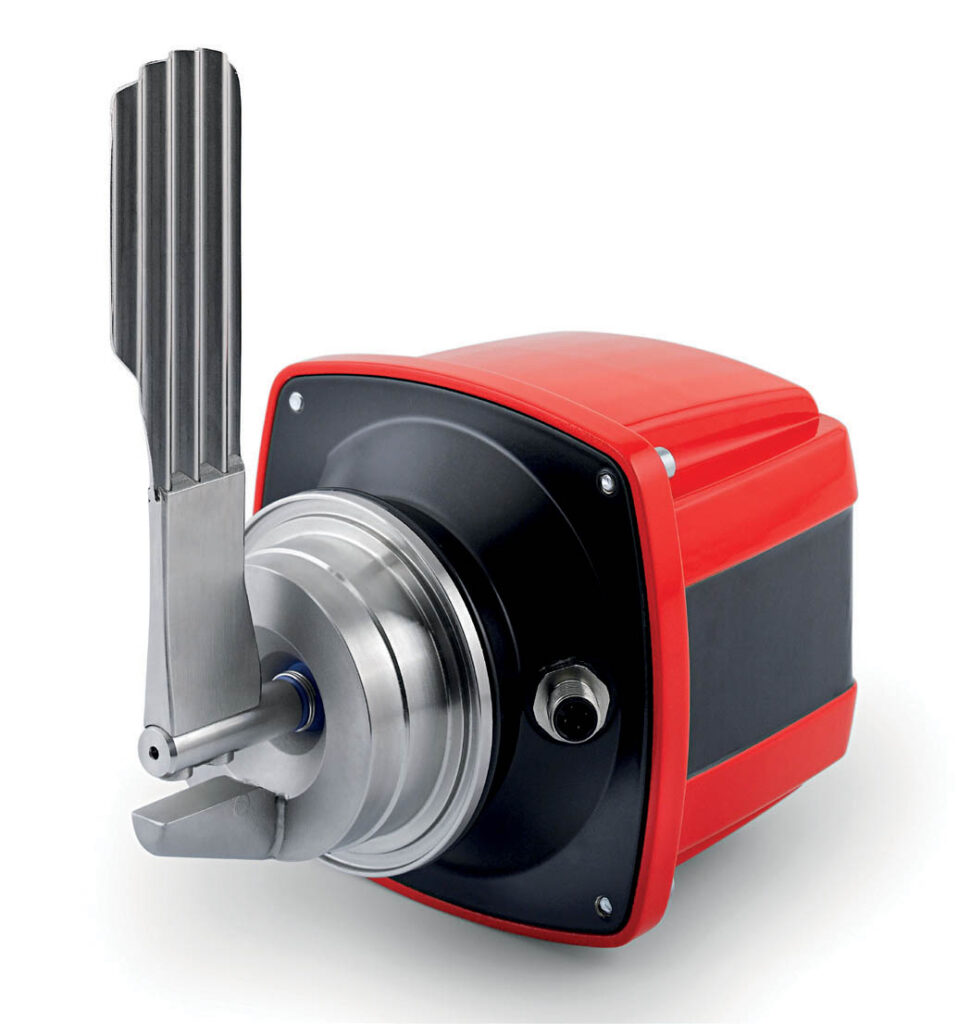
Another technology from BTG, called Ampliforce™, is now available for several years and it gives fiber consistency measurement performances almost close to rotating technology. Therefore, it deserves some more explanations. The Ampliforce™ technique for consistency measurement, uses an active sensor oscillating at its resonance frequency. It combines measurement of shear force and viscoelastic properties to obtain higher sensitivity and better signal quality than conventional blade consistency transmitters.
The transmitter equipped with this technology combines a high and dynamic sensitivity to fiber consistency with a low sensitivity to normal variations in fiber composition, freeness, flow velocity, air content, pressure, etc. ACT-2500 is the consistency transmitter commercialized by BTG with the Ampliforce™ technology. The ACT-2500 is characterized by its capability of measuring fiber consistency accurately and precisely up to 7% and at even as low as 1%, with only one sensing element.
The underlying reason for the improved sensitivity is that, in contrast to conventional shear force transmitters, the Ampliforce™ consistency transmitter is not solely dependent on the break-down of the fiber network caused by a blade or sensing element of a rotating transmitter, but also depends on the viscoelastic damping effect of fiber network.
About installation, the ACT-2500 is mounted on a simple weld-in stud and it has the great advantage of requiring shorter minimum calming length than blade sensors. Initial investment is reduced and the ACT-2500 can be maintained with suitable maintenance for several years of operation at minimum cost. As a consequence, this technology gives very good return on investment.
Case studies
Broke consistency issues solved in a premium quality packaging mill. In a modern and large capacity premium quality packaging mill in Northern Europe, broke consistency control was seriously disturbed by varying flows and different broke types. Sometimes operators had to control it manually and board machine has even been completely stopped due to activation of a fail-safe at 5% consistency because of a wrong consistency information. Flows are influenced by production and availability of broke, which can be of different sources like cartonboard, containerboard or liquid packaging board.
Broke lines were initially equipped with static blade consistency transmitters which gave insufficient performance. While the static blade sensors were replaced by much more expensive microwave consistency transmitters, the performances of the broke consistency control loops were unfortunately still not at the required level to ensure correct machine operation, likely because of uncontrolled air content in the stock.
The simple installation of six Ampliforce™ consistency transmitters from BTG was the best cost-effective solution finally. The transmitters provide fiber consistency of broke accurately, without disturbance from flow variation, air content or broke type. There is no complaint anymore about the negative influence from broke consistency and the mill can operate at the best conditions.
Mass flow variation reduced in tissue mill using virgin fibers and deinked pulp. A leading tissue mill in Northern Europe using various types of fiber to produce different toilet paper and towel grades experienced unstable consistency variation in approach flow. The fiber mixes were made of SW, CTMP or DIP from office waste and magazines.
The recipes were so diverse that it was not possible to work with different calibration sets. Ampliforce™ consistency transmitters were installed successfully on mixing chest and machine chest, demonstrating capability to handle heterogeneous fiber mixes and providing high accuracy at these sensitive process locations. This better fiber consistency control reduced mass flow variation and enabled basis weight reduction and fiber savings.
NSSC pulp operation issues solved. In a pulp mill in Northern Europe with consistency control at NSSC (Neutral Sulfite Semi Chemical) production unit was disturbed by the plugging of static blade sensor and its flow aligners. The installation of ACT-2500 Ampliforce™ consistency transmitter removed immediately the problem with limited cost as pulp maker appreciated very good consistency measurement as well as shorter calming length required.
Improved basis weight stability in white-top testliner mill. A packaging mill in Southern Europe making testliner experienced basis weight variations on white-top layer impacting runnability and quality. Despite total consistency measured by an optical sensor was under control at machine chest, the automation staff was not able to fine tune the basis weight control loop correctly. Some process investigations showed significant variation of fines and fillers content, leading to variation of fiber content as part of total consistency.
Consequently, it was decided to install a shear-force consistency transmitter at the machine chest with sufficient accuracy for basis weight control. ACT-2500 Ampliforce™ consistency transmitter accomplished the mission successfully, by providing an accurate fiber consistency signal in accordance with stability of white-top layer basis weight.
Better mass flow control of mechanical pulp. An integrated mill in Northern Europe identified inaccurate mass flow control of PGW (pressurized ground wood) to the paper machines. The consistency measurement on this line was ensured by a static blade consistency transmitter visibly not reliable enough to keep target of 4.5% consistency. An upgrade, by installing an ACT- 2500 Ampliforce™ consistency transmitter on this line, gave immediate satisfaction by improving mass flow measurement and control.
Optimized dosage of polymer in sludge dewatering. A mill producing tissue from recycled fiber is handling sludge in a dewatering process and the dewatered sludge is burnt in an incineration plant. Beneficiary for the process economy is high dry solids content of the dewatered sludge, high capacity of the screw presses and low suspended solids content in the reject from the dewatering units. Before the dewatering and screw press a flocculent polymer is added to make dewatering of the sludge possible.
Variations in the sludge entering the dewatering plant are a limiting factor for the operations of the whole process. The composition of the sludge will have great effect on the need for polymer dosage. The consistency of the sludge is of great importance for the polymer dosage control. The consistency varies in the range 2-6 % and until now it has been difficult to measure the consistency of this media. Ash content of almost 60 % and low shear force have made the task impossible for several traditional consistency measuring techniques.
Instead of dosing polymer based on volumetric flow of sludge, it is now added based on the flow of dry solids, thanks to consistency measurement provided with Ampliforce™ consistency transmitter installed after sludge tank and before the dewatering unit. In addition to higher dry solids and yield improvement at incineration plant, polymer consumption has been reduced with estimated savings of € 40,000 per year.
Conclusion
Pulp, paper, board and tissue makers have a nice alternative for accurate fiber consistency control. To face some process issues like not long straight pipe available, flow variations, complex fiber mixes, or basis weight instability, the amplitude method consistency measurement method is a valid and proven solution in multiple applications like in the case stories described before. To benefit from this cost-effective alternative, the sales and service teams from BTG are available locally to provide suitable advisory and support services to the mills.
CONSISTENCY CONTROL LOOP
Control of consistency is achieved by adjusting dilution to the defined consistency setpoint either manually or more commonly automatically with a proper consistency control loop. The efficiency of the control loop depends on several factors: Selection of the right consistency transmitter which depends on consistency range, fiber type and process application (as described in this article), and also on expected results and investment. Installation of the selected consistency transmitter at the right location. Appropriate sampling valve to get a right sample for laboratory measurement is required. Correct lab testing protocols with best repeatability as lab results are used for calibration. Right mixing of stock in the tank. Dilution line, dilution valve and dilution header well designed. Impact of pump in the mixing of dilution water with the stock. Tuning of the PID controller. All these elements determine the end-result of the consistency control loop.