The first barrier coatings for food packaging were made from synthetic polymeric chemicals known as per – and polyfluoroalkyl substances (PFAS). PFAS are a large family of compounds characterized by having multiple fluorine atoms attached to a saturated hydrophobic alkyl chain and bearing a hydrophilic functional group.
This structure gives PFAS the ability to readily repel water and grease. However, PFAS are highly persistent, mobile and bioaccumulative. Due to their environmental and health risks, their use is regulated globally, with some regions planning to phase them out entirely.
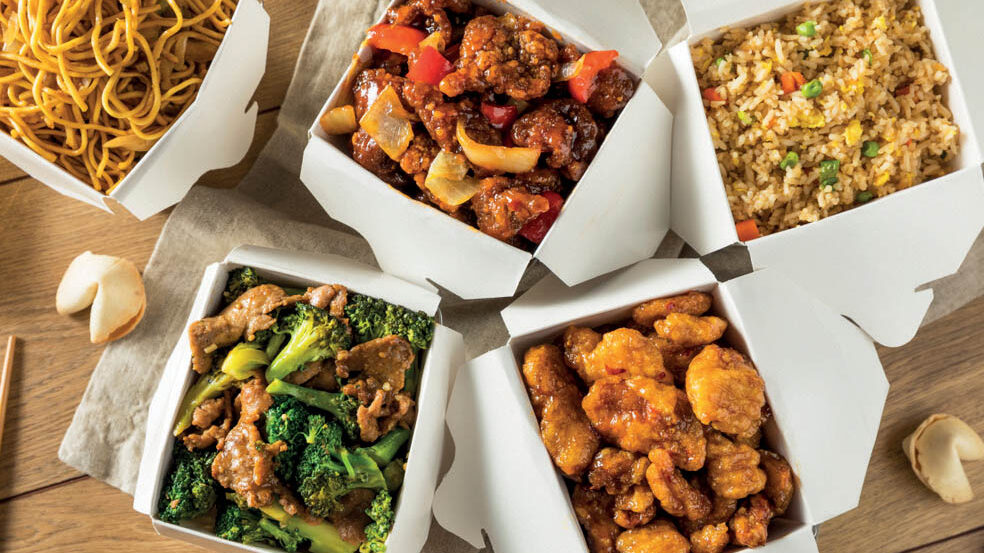
To increase water resistance and avoid the risks associated to PFAS, paper packaging is often coated with polyethylene (PE). However, separating PE from paper is complex and costly, reducing overall recyclability and contaminating the paper recycling stream. Approximately 40% of functional and barrier coatings on paper and board packaging are used for food packaging, with increasing demand in pet food and non-food applications.
This demand for barrier coatings is expected to grow by 4.8% in the coming years. Despite efforts to reduce reliance on oil-based coatings and eliminate PFAS, the packaging industry still seeks solutions that provide sufficient resistance to water, oil and grease. Archroma’s Cartaseal® OGB F10 offers a promising alternative. This water-based surface barrier imparts oil and grease resistance to paper packaging, enabling sustainable, highquality packaging that replaces fluorine and polyethylenebased substances.
Cartaseal® OGB F10 maintains its barrier properties after folding, making it suitable for folding boxes and flexible packaging applications. Moving towards safer solutions for the environment and the consumer is a major element of Archroma’s innovation strategy and they believe that it must not be detrimental to the performances and functionalities associated with traditional barrier coating.
Methods

- Oil and grease resistance – 3M Test Kit
The test for oil and grease resistance of the coated paper is performed according to the extended TAPPI T559 method. In this method, solutions of castor oil, toluene and n-heptane are prepared at defined concentrations. The solutions are numbered from 1 (least aggressive) to 16 (the most aggressive). A drop of these solutions is applied to the coated paper. After 15 seconds, the excess of the solution is removed. The highest numbered solution that does not stain the surface of the coated paper is reported as the KIT rating. - Oil and grease resistance – Cobb Test (1800s)
The Cobb Test is performed according to the standard method TAPPI T441 – Cobb Test for Paper and Packaging Industry originally designed for testing water absorptiveness. In this test, a specific amount of olive oil is placed on the surface of a coated paper of defined dimensions. After 1800 seconds, the excess of oil is removed and the weight of the paper sample is measured. The difference between the final and initial weight is reported as oil absorbed by the sample expressed in g/m2. - Crease test – TAPPI T512 Standard Method
The crease test was performed according to the standard method TAPPI T512 – Creasing Of Flexible Packaging Material Paper Specimens For Testing. In this method, two opposite corners of a square sample of coated paper are brought together to create a crease. A rubber covered crease roller is rolled once over the sample, without applying additional pressure, to form a crease. The sample is them unfolded and the operation is repeated to create two perpendicular creases. The samples are the tested according to the Cobb method.

Results and discussion

- Oil and grease resistance – 3M Test Kit
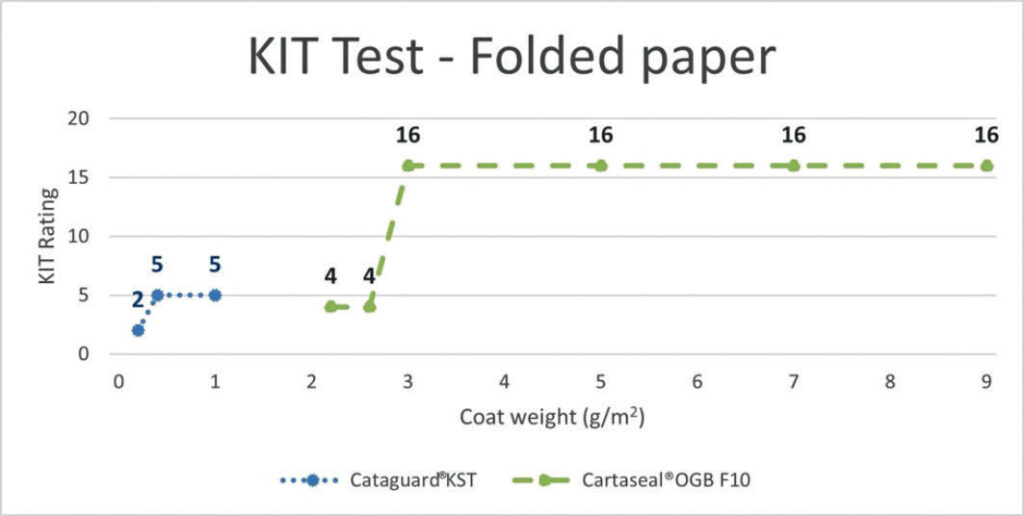
Paper samples coated with Cartaseal® OGB F10 and a fluorine-based coatings Cartaguard® KST respectively, were tested according to the extended TAPPI T559 method. As shown in Fig. 1, Cartaseal® OGB F10 reaches the highest KIT rating, 16, at a coat weight of 3g/m2 outperforming the fluorine-based alternative Cartaguard® KST. - Oil and grease resistance – Cobb Test (1800s)
A paper sample coated with Cartaseal® OGB F10 was tested according to the Cobb method. The results shown the barrier performance of Cartaseal® OGB F10 to olive oil. It can be observed a significant drop of the olive oil absorbed by the paper with a coat weight above 5. Oil and grease resistance of folded paper – 3M Test Kit The ability of the coating to maintain its barrier properties after folding is critical to folding box and flexible packaging applications. This is a clear limitation of most coatings available in the market and it’s hindering the replacement of plastic in flexible packaging, such as pouches or wraps. To evaluate the performance of Cartaseal® OGB F10 for this type of application, the KIT 3M is performed. The results of the KIT tests shown a reduced rating for the fluorine-based product Cartaguard® KST, dropping from 13 to 5 rating after folding. However, Cartaseal® OGB F10 is still reaching the highest rating, 16. - Oil and grease resistance of folded paper – Cobb Test (1800s)
The figures below show the comparative results of the Cobb test, performed with olive oil, on unfolded and folded paper samples coated with Cartaseal® OGB F10 and a conventional resin.
Conclusions
The packaging industry is under pressure to develop alternative solutions to plastic with paper often being the default choice. However, poor resistance to oil and grease is a natural limitation that need to be addressed to develop more sustainable and safer packaging alternatives solution. This study shows that excellent barrier to oil and grease can be achieved with Cartaseal® OGB F10. A water-based solution that performs to the highest standards even on folded papers.
Notes: Smither Pira “The Future of Functional and Barrier Coatings for Paper and Board to 2028” – Visual Feature – Beat Plastic Pollution (unep.org).
Back