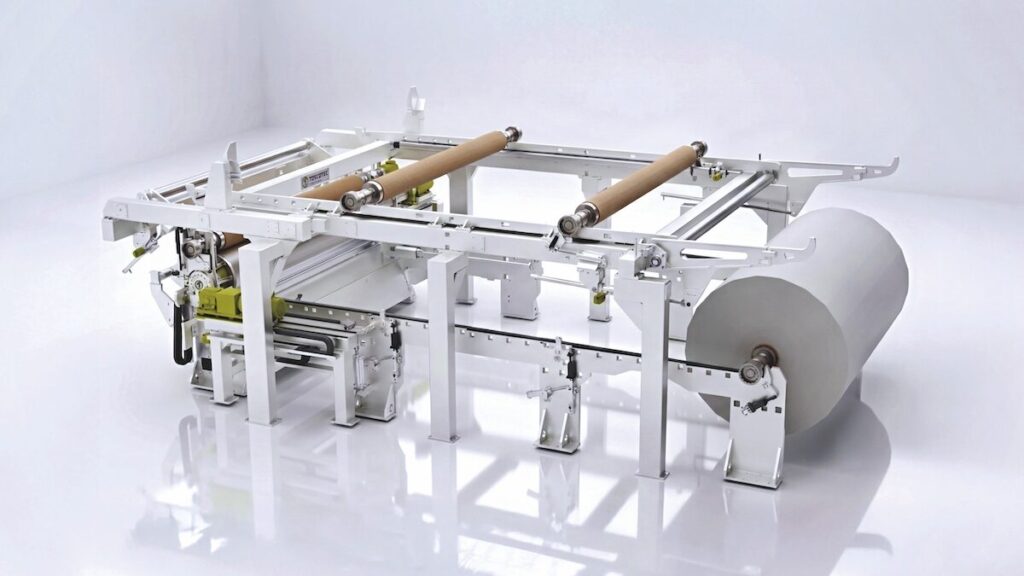

A primary objective within the tissue industry is preserving paper quality, particularly in terms of bulk and caliper uniformity in finished reels. This challenge is met by Toscotec’s TT BulkyReel: a new, state-of-the-art Pope reel designed to deliver exceptional product quality without compromising on operational efficiency.
Key advantages: electromechanical technology
Unlike traditional winding systems, TT BulkyReel is operated entirely by electromechanical control to better manage the nip load between the paper and the Pope reel drum throughout the entire winding process – achieving uniform bulk from the very first to the last wrap. This is obtained through Toscotec’s advanced Core Wind Assist (CWA) technology, applied to both the primary and secondary arms to reduce and precisely control the linear contact force (nip), which is recommended for high-quality bulky grades.
In addition, by transitioning to a fully electromechanical architecture, the system delivers distinct advantages across several key areas: thanks to greater control, it results in efficient winding with uniform roll edges and provides even density of the finished jumbo roll with caliper control, which results, respectively, in fewer lateral cut losses in the following operational phases and improved performances in either rewinding or converting.
Furthermore, the system achieves higher energy efficiency with minimal loss on the motors, utilizing IE2 under inverter or IE3 under DOL, reaching 88-89% efficiency for three-phase squirrel-cage motors and 92-93% for servomotors.
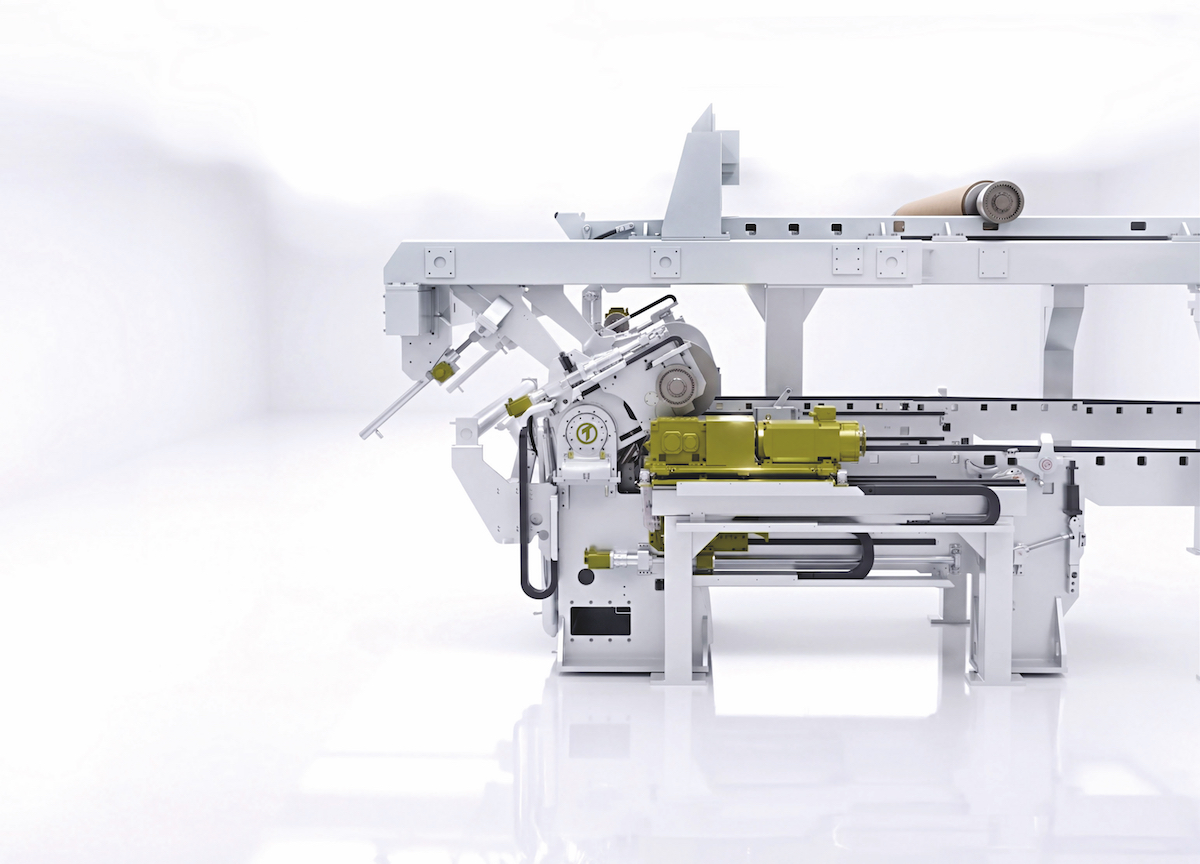
By completely eliminating the use of hydraulic oil, this innovative solution reduces the risk of product contamination and the frequency of required maintenance. Moreover, it directly allows paper mills to achieve a cleaner, safer, and more sustainable production environment.
Oil containment and supply are not necessary, and no hydraulic hoses are needed, resulting in clean on-machine cabling and piping. This oil-free design also reduces fire risk and delivers water savings, as no heat exchanger or related water conditioning circuit is required.
For ease of operation, a standalone cabinet makes it ready to run and easy to install, while the on-board machine assembly, connected through Profinet, is designed to reduce commissioning time with fewer cables. It features a dedicated and state-of-the-art controller with Motion and Safety Control alongside a user-friendly interface. The design requires fewer sensors, electromechanical components, terminals, and cables.
Finally, it is prepared for Papermaking 4.0 with OPC-UA and Cloud Connection, and it is ready for predictive maintenance with a Torque Monitoring System.
The operating principles of the TT BulkyReel
In terms of operating principle, the nip between the forming reel and the reel drum is constantly monitored by load cells, which control the electromechanical actuators that generate the nip force in a closed loop. This nip control results in a uniform nip at all paper roll diameters, real-time control through the DCS, and automatic tuning of the pressure curve.
The load cells support the reel drum on both the tender and drive sides, reading the nip force whether the spool is on the primary arms or the secondary arms, which results in continuous nip acquisition throughout the entire winding process. These load cells measure the nip force on two axes – in the vertical and horizontal directions – for optimized balance control.
During operations, the primary center wind synchronizes the empty spool and the drum speed – ensuring correct contact with the reel drum. Next, the secondary arms receive the winding spool from the primary arms, maintaining the forming reel in contact with the drum at the set nip.
The presence of CWA on the primary arms (installed on the drive side) and on the secondary arms (installed on the tender side) allows the TT BulkyReel to work with reduced nip values between the growing roll and the Pope reel drum. The nip value can be reduced to around 200 N/m or below, according to specific customer needs – while on conventional machines the typical value is 800-1000 N/m – resulting in higher final paper thickness and reduced caliper variation.
Field results and case studies
TOSCOTEC currently has many references for both conventional machines and TAD applications. Among these, the company has successfully executed several projects where standard reels with pivoting arms or traditional hydraulic controls were replaced by TT BulkyReels for high-quality tissue grades.
As a reference case, the installation of the TT BulkyReel allowed the customer to increase bulk and produce lower tensile grades. Previous attempts by the customer to run much higher bulk products were unsuccessful, mainly due to winding capability limitations. These caused loose winds, sheet handling issues, and nip bubbling. Such problems were linked to the technological limits of the previous equipment, which featured a pivoting reel with primary nip relieving and manual secondary nip control.

Following the installation of the TT BulkyReel, the product trial was repeated. With the same product specifications, the new reel demonstrated outstanding performance, with no reel winding concerns down to 175 N/m nip. Sheet handling remained stable, enabling the customer to also increase the finished roll diameter.
Furthermore, in-wound tension and caliper tests were completed and compared to the previous configuration. The results showed a much flatter in-wound tension curve throughout the roll and a reduction in caliper loss at the spool.
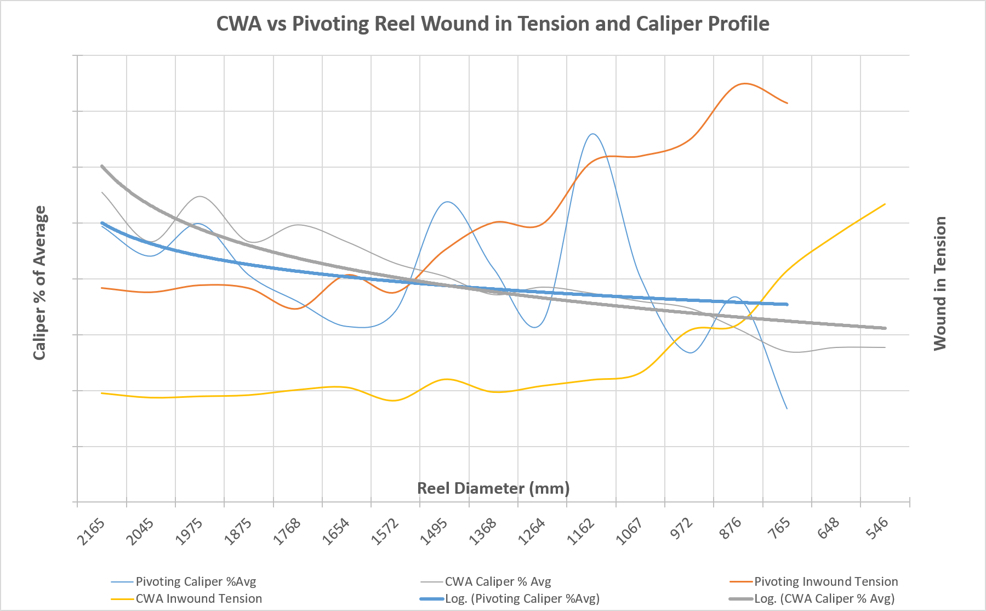
The customer was running a trial of a product that significantly increased caliper and presented significant challenges in the winding process with the previous traditional pivoting technology. While the caliper values have been removed to protect the customer’s data and not disclose any proprietary information, graph 1 shows significant improvement in caliper uniformity throughout the reel on the trial product between the new CWA reel and the old pivoting reel.
Similarly, the in wound tension absolute values were removed but demonstrate the advantages of the TT Bulky Reel.
Toscotec took samples and measured the caliper on a finished reel – at the beginning, in the middle, and at the end – to assess caliper variation throughout the reel. The results showed remarkably good performance in terms of caliper variation. Across all installations, data shows that the caliper variation measured on the TT BulkyReel is within 2.0 to 3.0% of the average at all positions with conventional paper, and within 4.5 to 5.5% of the average at all positions with structured paper. The typical value on a conventional reel is higher, which reduces the efficiency of the next operational phases.
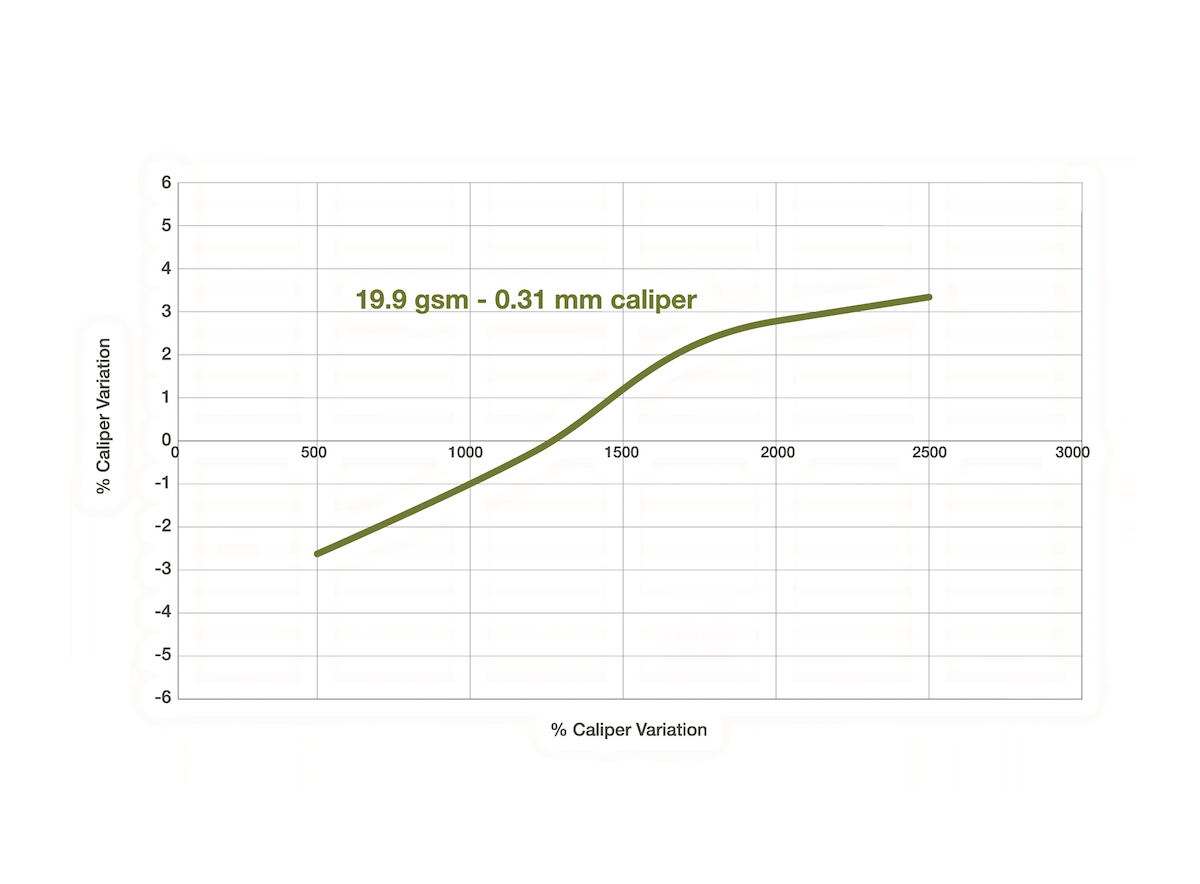
The reference data points measured on TAD machines are displayed in graph 2.
As tissue manufacturers continue to pursue higher-quality products, TT BulkyReel offers a solution that combines superior bulk preservation and minimal caliper variation, ensuring reel uniformity, and advancing the industry toward greater winding excellence and operational efficiency.
Back